
Explaining the Process of Mold Remediation in Bayfront Homes in North Miami
Bayfront homes in North Miami offer open water views and steady coastal breezes, but they also face one constant pressure: moisture. Between Biscayne Bay’s humidity, seasonal storms, elevated groundwater, and nonstop air conditioning use, these properties operate in an environment where mold growth is always a possibility.
When mold becomes established, proper remediation is not a surface cleaning job. It’s a structured, controlled process designed to remove contamination, correct moisture issues, and prevent recurrence.
Understanding how mold remediation works in bayfront homes helps property owners make informed decisions and avoid shortcuts that lead to repeat problems.
Why Bayfront Homes Face Unique Mold Challenges
Living near Biscayne Bay means dealing with:
- Year-round high humidity
- Wind-driven rain
- Salt-laden air
- Hurricane-related roof stress
- Slab moisture migration
- Continuous HVAC operation
Even well-built homes in North Miami, Miami Shores, and nearby Biscayne Park are vulnerable if moisture control slips.
Because coastal humidity rarely drops significantly, materials that become damp do not dry quickly on their own.
That’s why remediation in this environment must address both contamination and moisture correction.
Step 1: Comprehensive Mold Inspection
The remediation process begins with inspection.
Before removing anything, professionals evaluate:
- Visible mold growth
- Moisture levels inside walls and floors
- Indoor humidity
- HVAC system involvement
- Roof and window integrity
- Slab moisture readings
Thermal imaging and moisture meters help identify hidden dampness.
In bayfront homes, moisture often spreads laterally through insulation before appearing visibly.
Without inspection, remediation may miss affected areas.
Step 2: Identifying and Correcting the Moisture Source
Mold does not grow without moisture.
Common moisture sources in North Miami bayfront homes include:
- Roof flashing failures after storms
- Window seal intrusion from wind-driven rain
- AC drain line clogs
- Duct condensation
- Slab moisture from rising groundwater
- Plumbing leaks inside walls
Remediation without fixing the source guarantees recurrence.
Moisture correction may involve:
- Sealing windows
- Repairing roof components
- Clearing HVAC drains
- Improving ventilation
- Installing dehumidification systems
Addressing the root cause is the foundation of long-term success.
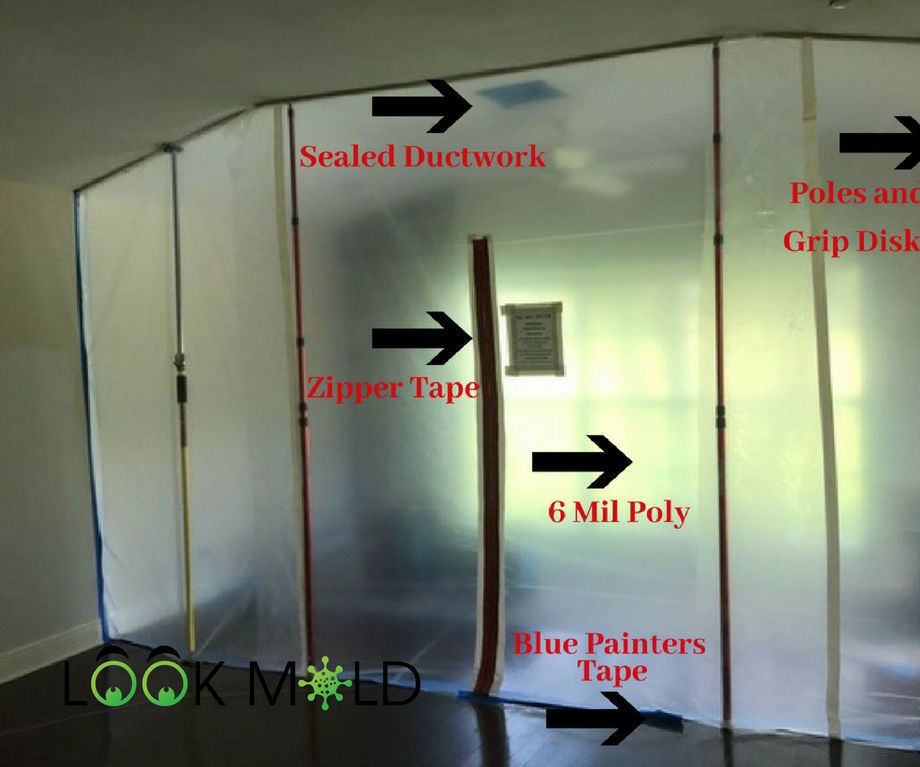
Step 3: Establishing Containment
Before mold removal begins, the affected area must be isolated.
Containment prevents spores from spreading to clean areas of the home.
This typically includes:
- Plastic barriers
- Sealed doorways
- Negative air machines
- Controlled airflow direction
In high-value bayfront properties or multi-story homes, containment protects unaffected rooms from cross-contamination.
In coastal climates where HVAC systems circulate air continuously, isolation is especially important.
Step 4: HEPA Air Filtration
During remediation, airborne spores are disturbed.
HEPA air scrubbers filter contaminated air and capture microscopic particles.
In North Miami’s humid environment, spores can remain suspended longer due to moisture in the air.
Continuous filtration reduces airborne contamination during removal.
This step protects both the structure and indoor air quality.
Step 5: Removal of Contaminated Materials
Porous materials that are heavily colonized must be removed.
This may include:
- Drywall
- Insulation
- Carpet padding
- Baseboards
- Ceiling materials
In slab-on-grade homes near Biscayne Bay, lower drywall sections are often removed if moisture migrated upward.
Removing damaged materials eliminates embedded mold that cannot be fully cleaned.
Selective demolition prevents unnecessary destruction while ensuring thorough remediation.
Step 6: Cleaning and Antimicrobial Treatment
Once contaminated materials are removed, exposed structural elements are cleaned.
This may include:
- HEPA vacuuming
- Wire brushing of framing
- Application of antimicrobial solutions
In coastal homes, salt exposure can combine with moisture to weaken wood framing.
Thorough cleaning ensures no residual contamination remains.
Surfaces must dry completely before reconstruction begins.
Step 7: Structural Drying
Drying is critical in North Miami’s humid climate.
Industrial dehumidifiers and air movers reduce moisture levels inside framing and subfloors.
Moisture readings are monitored daily.
Drying continues until materials reach safe, stable levels.
Skipping verification often leads to mold recurrence weeks later.
Because coastal humidity slows evaporation, this stage may take longer than inland projects.
Step 8: HVAC Inspection and Duct Evaluation
Mold spores often circulate through HVAC systems.
In bayfront homes where AC runs almost constantly, duct inspection is essential.
If contamination is found inside ducts or air handlers, air duct cleaning may be required.
Failing to address HVAC involvement can reintroduce spores after remediation.
Proper evaluation ensures the entire system supports clean indoor air.
Step 9: Clearance Testing (If Needed)
After remediation and drying, clearance testing may be conducted.
Air samples compare indoor spore levels to outdoor baseline levels.
If indoor counts return to normal ranges, the area is cleared for reconstruction.
Clearance testing provides confirmation that remediation was successful.
Step 10: Reconstruction
Once moisture and contamination are resolved, rebuilding begins.
This may include:
- Installing new drywall
- Replacing insulation
- Repainting
- Reinstalling flooring
- Repairing cabinetry
Reconstruction should never begin before moisture levels are verified as stable.
Patience during drying protects long-term structural integrity.
Mold Remediation in High-Humidity Conditions
Bayfront North Miami homes face an ongoing challenge: humidity rarely disappears.
Even after remediation, preventive measures must continue.
Maintaining indoor humidity between 45% and 55% reduces recurrence risk.
Whole-home dehumidifiers may be recommended in waterfront properties.
Regular HVAC servicing ensures systems regulate moisture effectively.
Coastal weather requires ongoing attention.
Common Mistakes to Avoid
Property owners sometimes attempt to:
- Clean visible mold without containment
- Paint over stains
- Replace drywall without drying framing
- Ignore HVAC systems
- Skip moisture detection
In humid coastal environments, shortcuts lead to recurring problems.
Professional remediation ensures the issue is fully resolved.
Why Local Coastal Experience Matters
Mold remediation in bayfront homes requires understanding:
- How wind-driven rain enters structures
- How slab moisture behaves near Biscayne Bay
- How salt exposure weakens materials
- How humidity affects drying timelines
- How HVAC systems perform in coastal climates
A restoration professional familiar with North Miami, Miami Shores, Biscayne Park, and Aventura understands these environmental patterns.
Tip Top Water and Fire Damage Restoration has handled mold remediation throughout these bayfront communities, applying strategies designed specifically for South Florida’s climate.
Local expertise leads to accurate diagnosis and durable solutions.
A Practical Perspective
Mold remediation in bayfront homes in North Miami is not simply about removing visible growth.
It involves:
- Identifying moisture sources
- Containing contamination
- Removing affected materials
- Cleaning structural framing
- Drying thoroughly
- Verifying stability before rebuilding
Coastal humidity adds complexity to every stage.
When handled properly and promptly, remediation restores both structure and indoor air quality.
In waterfront communities near Biscayne Bay, structured action and environmental awareness ensure that mold problems are resolved — not temporarily hidden.
Understanding the process helps property owners protect their homes against the ongoing moisture pressures of coastal South Florida.