
How Coastal Weather Influences Moisture Detection in Biscayne Park
Biscayne Park may not sit directly on the ocean like Surfside, but it lives under the same coastal weather patterns that define life near Biscayne Bay. High humidity, heavy seasonal rain, tropical systems, and elevated groundwater levels all influence how moisture behaves inside homes.
For property owners in Biscayne Park, moisture detection isn’t just about finding obvious leaks. Coastal weather changes how water travels, where it hides, and how quickly it creates structural problems.
Understanding these weather-driven patterns helps explain why professional moisture detection in this area requires both the right tools and local experience.
Why Coastal Climate Changes the Way Moisture Behaves
In inland areas, moisture intrusion often follows a simple pattern: a pipe bursts or a roof leaks, and visible damage appears nearby.
In coastal communities like Biscayne Park, moisture movement is more complex because:
- Outdoor humidity remains elevated most of the year
- Wind-driven rain enters structures horizontally
- Salt exposure weakens seals and flashing
- AC systems run constantly, creating condensation
- High water tables affect slab foundations
These factors mean moisture doesn’t always stay where it starts.
Detection requires understanding how coastal weather interacts with building materials.
High Humidity and False Positives
One of the biggest challenges in moisture detection in Biscayne Park is distinguishing between actual leaks and humidity-driven dampness.
When humidity levels rise above 70%, drywall, wood trim, and even concrete can absorb surface moisture from the air.
This creates elevated readings on moisture meters — even without active leaks.
Experienced inspectors know to:
- Measure ambient humidity first
- Compare readings across multiple areas
- Evaluate patterns rather than isolated spots
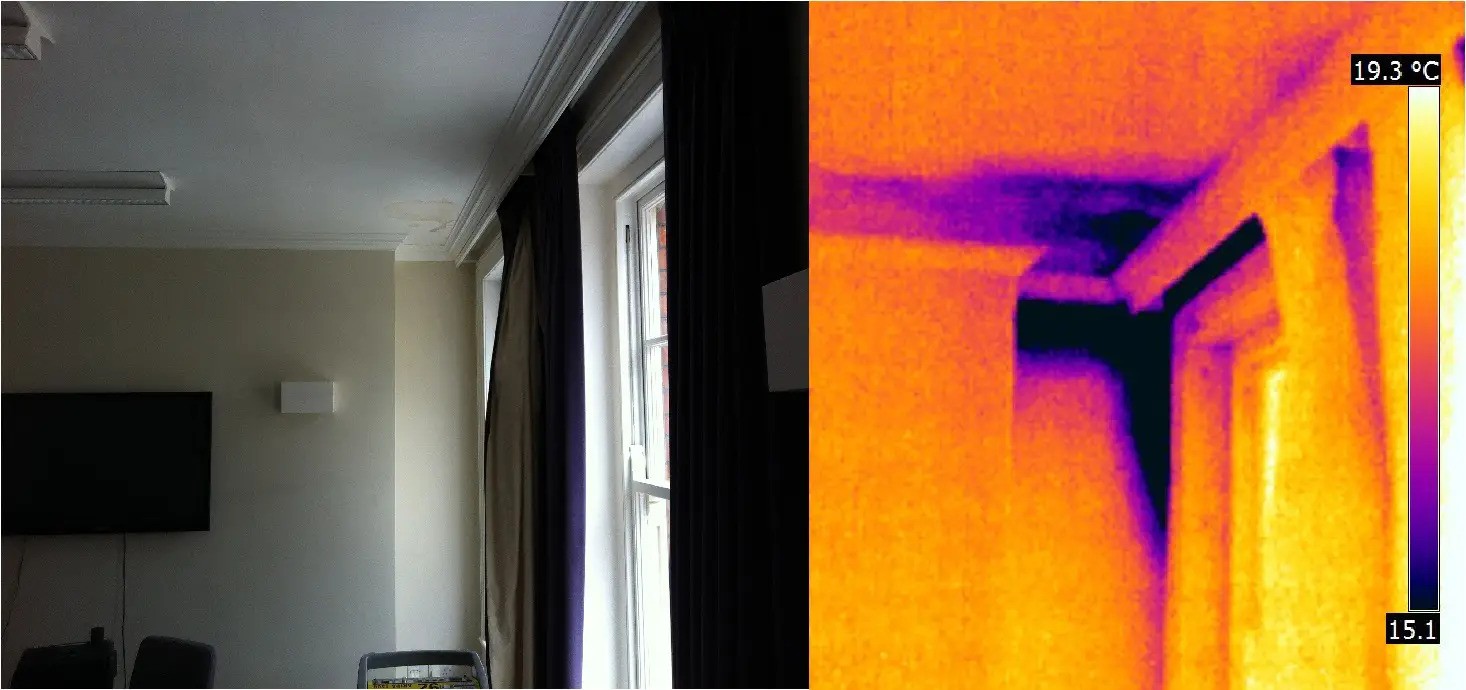
- Cross-check with thermal imaging
Without context, high humidity can be mistaken for plumbing failure.
Proper detection means understanding environmental baselines before drawing conclusions.
Wind-Driven Rain and Exterior Wall Intrusion
Biscayne Park experiences heavy seasonal storms similar to nearby North Miami and Miami Shores.
During strong storms, rain doesn’t fall straight down. It’s pushed against structures by wind pressure.
Water may enter through:
- Window frame gaps
- Door thresholds
- Exterior wall penetrations
- Roof flashing seams
Unlike plumbing leaks, wind-driven intrusion often dries partially between storms — making detection more difficult.
Moisture mapping helps identify repeating damp areas that correspond to storm exposure.
Inspectors frequently focus on exterior-facing walls and ceiling corners after major rain events.
Roof Systems Under Coastal Stress
Flat and low-slope roofs common in South Florida are particularly vulnerable during hurricane season.
Strong winds lift flashing and stress sealants. Even minor separations allow slow leaks.
Moisture may accumulate in attic insulation long before interior staining appears.
In Biscayne Park homes, inspectors often evaluate:
- Attic roof decking
- Insulation compression
- Rusted fasteners
- Discolored truss areas
Thermal imaging helps detect damp insulation even when drywall below appears dry.
Weather timing plays a major role. Moisture detection shortly after storms often reveals issues that might otherwise remain hidden.
Elevated Groundwater and Slab Moisture
Biscayne Park sits near coastal waterways, and groundwater levels rise during heavy rains.
Slab-on-grade homes are particularly affected.
Moisture can migrate upward through concrete slabs, especially when outdoor saturation increases.
Signs of slab moisture include:
- Darkened grout lines
- Warped wood flooring
- Damp carpet padding
- Musty smells near baseboards
Moisture meters placed along slab edges help determine whether readings are surface-level or structural.
Distinguishing between groundwater migration and pipe leaks requires professional evaluation.
AC Systems and Weather Interaction
Air conditioning systems are essential in Biscayne Park homes.
However, weather directly affects HVAC performance.
When outdoor humidity spikes:
- AC systems run longer
- Condensate output increases
- Drain lines may clog
- Duct condensation becomes more likely
Moisture detection often includes inspection of:
- Air handler compartments
- Ceiling areas below duct runs
- Mechanical closets
Condensation-related moisture is common in South Florida.
Understanding weather patterns helps inspectors determine whether dampness is environmental or mechanical in origin.
Seasonal Changes and Detection Accuracy
Moisture detection results vary by season.
During dry months, readings may appear normal even if small leaks exist.
During rainy months, elevated readings may reflect environmental saturation rather than structural failure.
Experienced inspectors in Biscayne Park consider:
- Recent rainfall history
- Humidity trends
- Storm exposure
- Wind direction during heavy rain
Context matters.
Detection without understanding seasonal weather patterns often leads to misdiagnosis.
Plumbing Leaks in Coastal Environments
Traditional plumbing leaks remain common in Biscayne Park, particularly in older homes.
However, coastal weather accelerates material wear.
Salt exposure affects:
- Outdoor hose connections
- Copper fittings
- Metal shutoff valves
- Water heater components
Small corrosion-driven leaks may develop slowly.
Moisture detection tools help identify elevated readings behind walls before visible damage appears.
Combining visual inspection with meter readings ensures accurate assessment.
Hidden Moisture Pathways in Coastal Homes
Water rarely travels in straight lines.
In Biscayne Park homes, moisture often spreads through:
- Insulation
- Wood framing
- Electrical conduits
- Ceiling cavities
Because humidity is already high, damp materials dry more slowly.
Moisture detection involves mapping the full extent of dampness rather than focusing only on visible stains.
Failure to detect hidden spread increases mold risk.
The Link Between Moisture Detection and Mold Prevention
In coastal climates, mold growth follows moisture quickly.
If damp areas remain untreated for more than 24 to 48 hours, microbial growth becomes likely.
Moisture detection plays a critical preventive role by:
- Identifying leaks early
- Confirming proper drying
- Preventing mold colonization
- Reducing structural deterioration
Professional inspection often prevents the need for later mold remediation.
Why DIY Detection Often Misses Coastal Patterns
Homeowners sometimes rely on visual cues alone.
However, in Biscayne Park’s coastal environment:
- Leaks may appear only during storms
- Condensation mimics plumbing issues
- Slab moisture resembles surface dampness
- Insulation hides water migration
DIY detection lacks:
- Thermal imaging technology
- Professional moisture mapping
- Experience interpreting humidity-influenced readings
Surface dryness does not guarantee structural dryness.
Professional tools provide clarity.
Preventive Moisture Monitoring
Because coastal weather patterns are ongoing, periodic inspection makes sense.
Preventive steps include:
- Annual roof inspection before hurricane season
- Monitoring indoor humidity
- Inspecting window seals
- Checking AC drain lines
- Scheduling periodic moisture detection assessments
In nearby communities like North Miami Beach and Aventura, similar preventive monitoring helps homeowners avoid larger restoration costs.
Moisture awareness is a long-term strategy in coastal living.
Why Local Experience Matters
Moisture detection in Biscayne Park requires understanding local climate behavior.
A restoration professional familiar with coastal South Florida understands:
- How wind-driven rain enters structures
- Where slab moisture migrates
- How salt exposure weakens building materials
- How seasonal humidity affects readings
Tip Top Water and Fire Damage Restoration has conducted moisture detection throughout Biscayne Park, North Miami, Miami Shores, and surrounding coastal neighborhoods, addressing weather-influenced patterns specific to this region.
Local expertise improves accuracy and prevents unnecessary demolition.
A Practical Perspective on Coastal Moisture Detection
Coastal weather doesn’t just cause leaks — it influences how leaks appear, how moisture spreads, and how quickly damage develops.
In Biscayne Park, moisture detection is about understanding environmental context.
By combining proper tools with local knowledge, inspectors can:
- Differentiate between humidity and leaks
- Identify hidden storm intrusion
- Detect slab moisture early
- Prevent mold growth
- Protect structural integrity
Coastal living means moisture will always be present.
Accurate detection ensures it doesn’t turn into a larger problem.